Two complete product audits, February and June 2026
Method
Observe → Diagnose → Hypothesize → Design state architecture → Build implementation → Define experiments → Connect to revenue
Validation
Research was shared internally with Notion’s Head of EMEA Marketing following publication.
Author
Isaac Olukoya · Perennus · August 2026
Central thesis
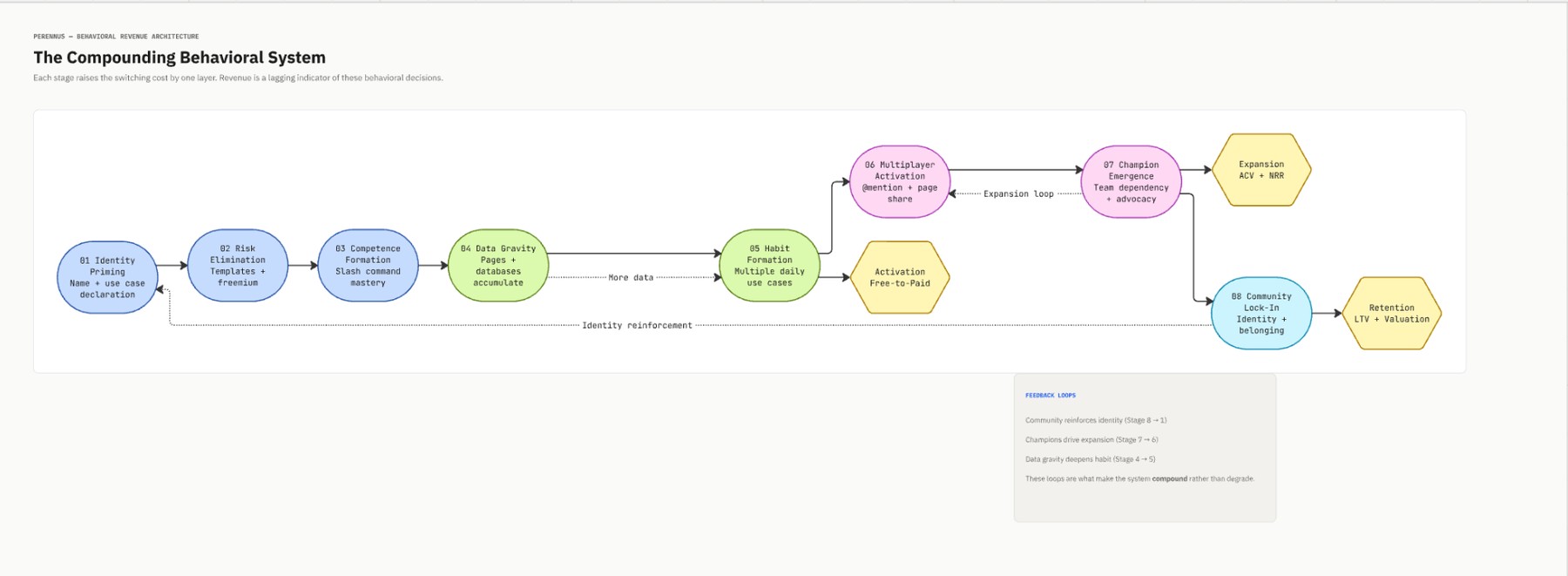
Notion’s growth is best understood as a compounding behavioural sequence: identity priming → competence formation → habit engineering → data gravity → collaboration → champion emergence → community lock-in. Each stage raises the switching cost by one layer. The revenue is a lagging indicator of these decisions.
Primary observed gap
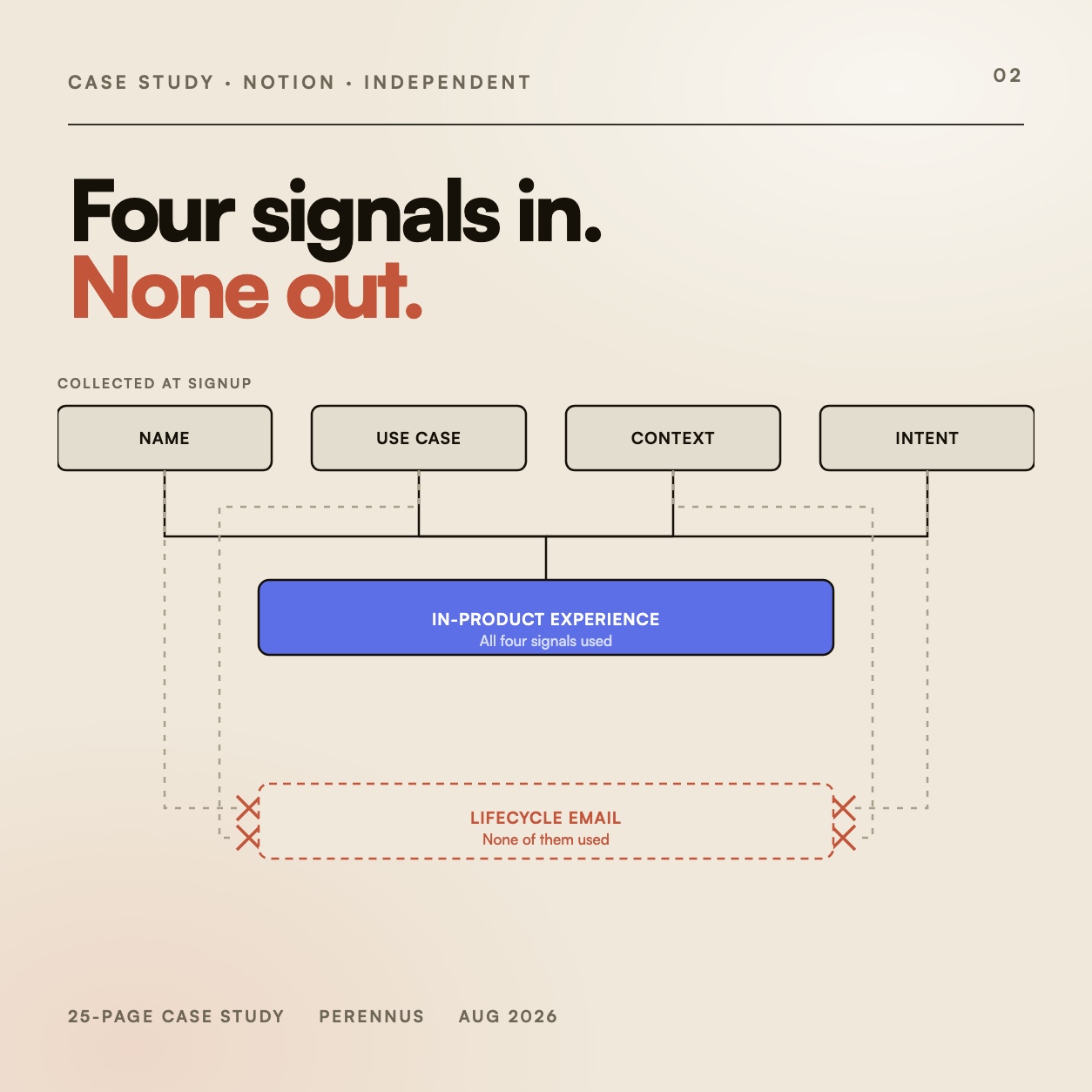
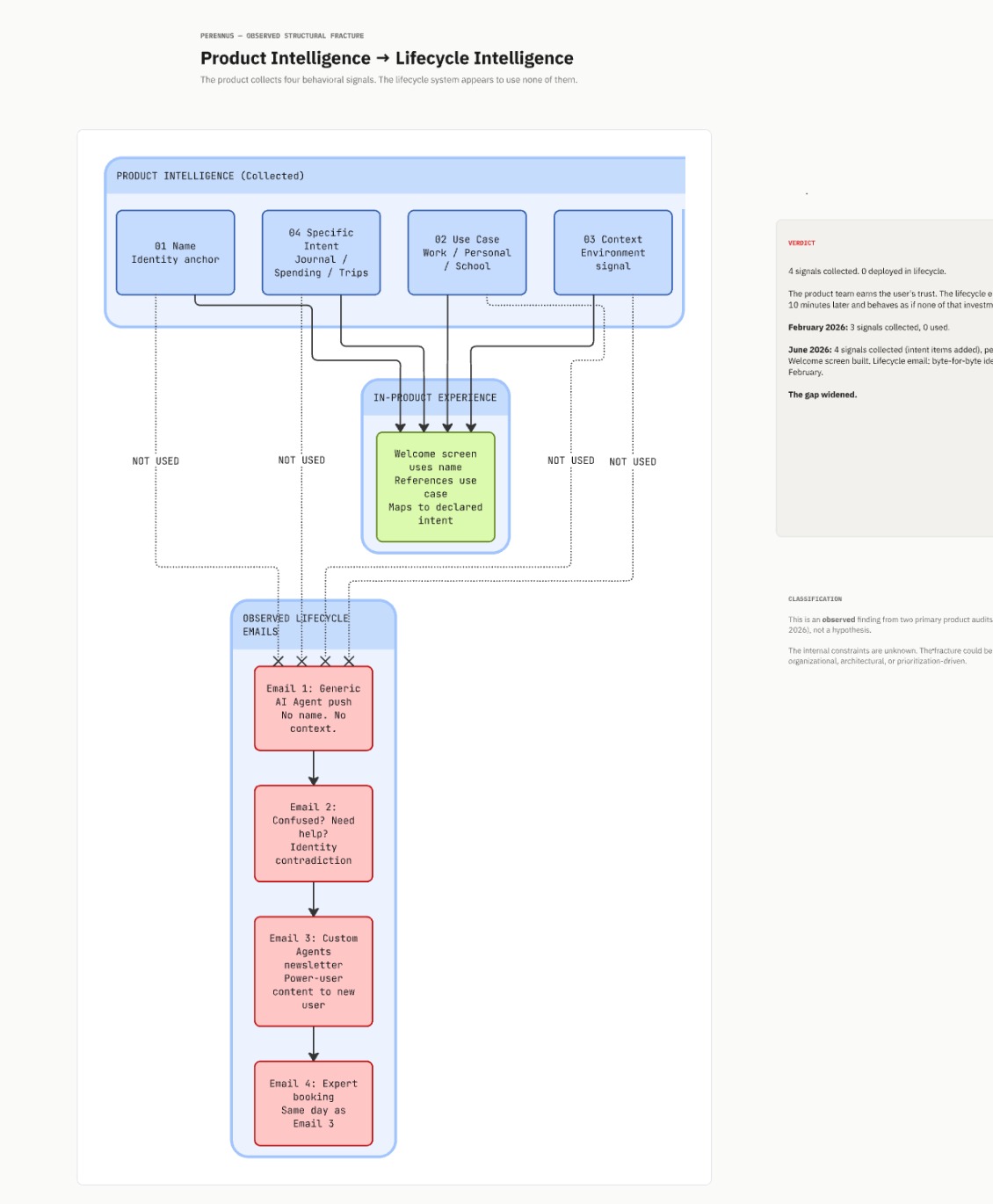
Notion’s onboarding collects four behavioural signals — name, use case, context and specific intent items. The in-product experience deploys all four. The lifecycle email system appears to deploy none of them. This gap widened between February and June 2026.
Primary hypothesis Hypothesis
Notion’s AI transition may produce faster early activation but shallower long-term behavioural investment. This is a hypothesis requiring internal cohort data to test, not a confirmed finding.
Methodology
Observe → Diagnose → Hypothesize → Design state architecture → Build implementation → Define experiments → Connect to revenue.
Two primary product audits (February and June 2026), published behavioural psychology research, SaaS benchmark data, and a post-publication conversation with Notion’s Head of EMEA Marketing, who engaged with the original research and shared it internally.
How to read this
What I observed, what I hypothesised, and what I proposed are different things. Every section says which it is.
Model
My framework for reading the system.
Observed
Recorded in two product audits, February and June 2026.
Hypothesis
Not a finding. Testing it needs internal cohort data.
Proposed
What I would build and test. Not Notion’s architecture.
Generalisation
The pattern beyond this one company.
01 · The architectureModel
The compounding behavioural system
Notion did not build a note-taking tool. It built a behavioural system where each layer of user investment makes the next more likely and the exit more costly.
Artifact 01Behavioural Revenue Architecture — the eight stages, the feedback loops between them, and the commercial outcome each produces. Open full size ↗
Stage
Mechanism
What it produces
01
Identity priming
Name + use case declaration before any feature
Commitment bias. User tells the product who they want to become.
02
Risk elimination
Templates transfer competence; freemium removes financial risk
Time-to-value collapses. Blank page fear neutralised.
03
Competence formation
Slash command creates feeling of command, not navigability
Self-efficacy. Users return to activities where they feel capable.
04
Data gravity
Every page, database, linked task increases cost of leaving
Switching cost grows automatically with usage.
05
Habit formation
Multiple use cases drive multiple daily opens
Products opened daily become infrastructure.
06
Multiplayer
@mention or page share makes leaving disrupt someone else
Interpersonal switching cost — categorically stronger than product lock.
07
Champion
Power user builds workspace their team depends on
Unpaid internal advocate. Enterprise deal starts from ‘yes.’
08
Community lock-in
Identity partially constructed around the product
Leaving = self-erasure. Social switching cost no import tool addresses.
Retention is not held by any single stage. It is held by the sequence. A user at stage 4 is retained through data gravity. A user at stage 6 is retained through social accountability. A user at stage 8 is retained through identity — and identity is not migrated by any import tool.
Products that sell features compete on capability. Products that sell identities compete on belonging.
02 · The fractureObserved
Product intelligence → lifecycle intelligence
The strongest observed finding is a structural disconnect between the behavioural intelligence the product collects and the behavioural intelligence reflected in the lifecycle experience.
What the product collects
Signal
What it reveals
Potential lifecycle use
01
Name
Identity anchor
Personalisation across all communications
02
Use case (work / personal / school)
Intent category — first segmentation layer
Email sequence routing, activation path selection
03
Context
Environment signal
Content framing, feature prioritisation
04
Specific intent items (June 2026)
Granular declaration: spending, journal, projects, research
Micro-activation paths, template recommendations
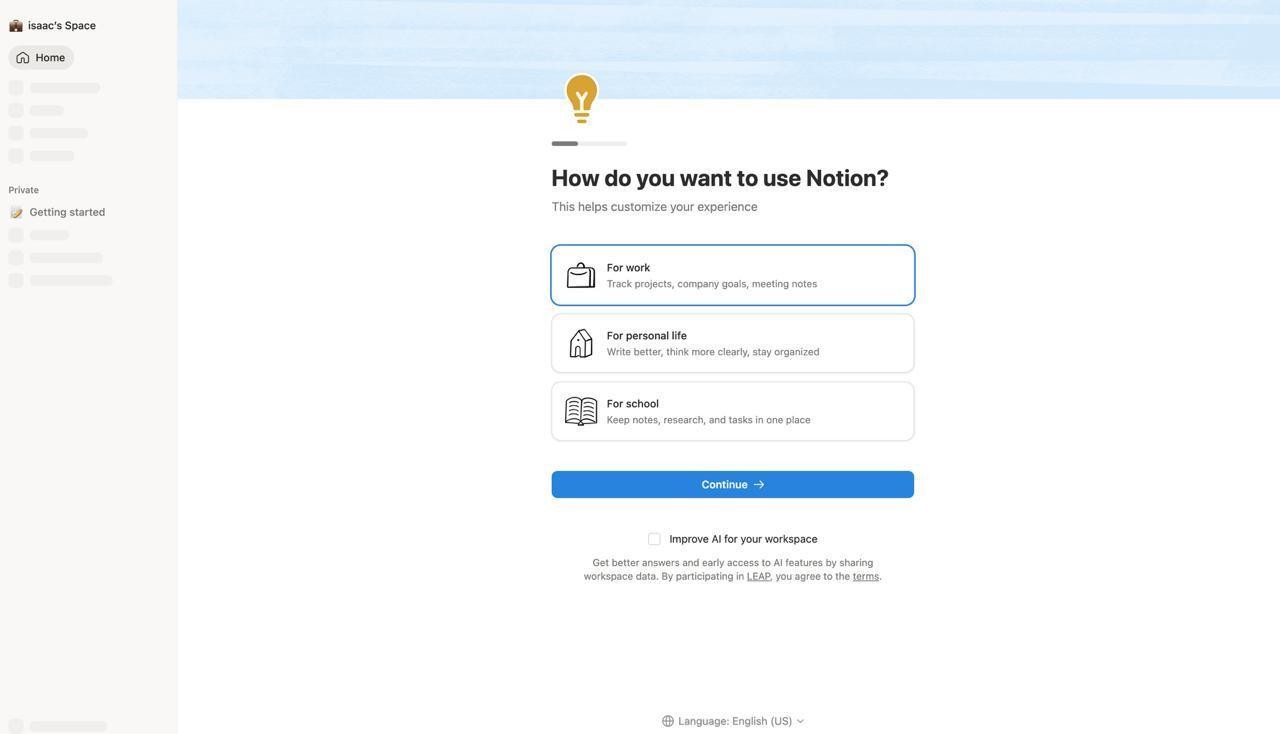
Notion’s own screenThe declared use-case selection — For work / For personal life / For school. The first segmentation layer. Open full size ↗
What the in-product experience does
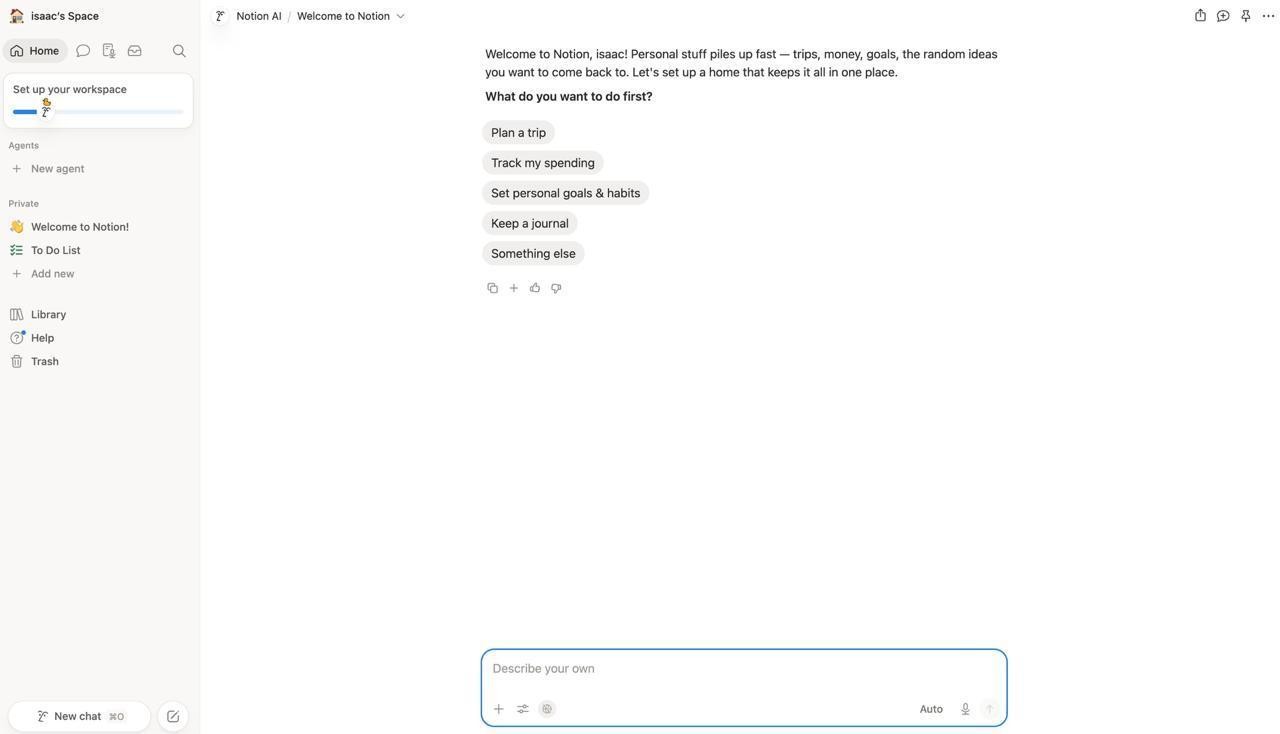
The product uses these signals. The June 2026 welcome screen addresses the user by name, references their use case, and presents intent-specific options. The behavioural data collected during onboarding is actively deployed to personalise the first session.
What the lifecycle email does
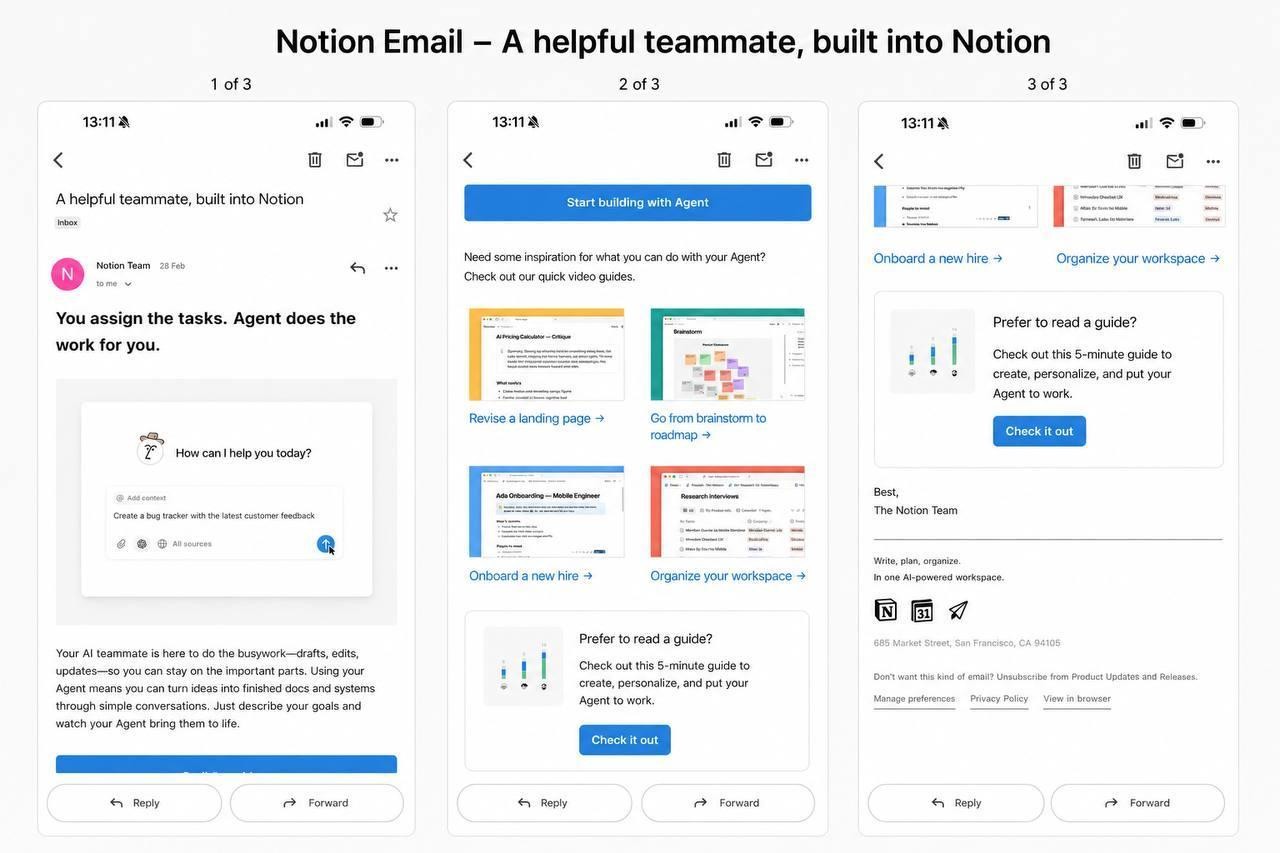
The lifecycle email appears to use none of these signals. In both audits, the first email promoted the AI Agent to a user who had not established basic activation. No name. No reference to declared use case. A user who selected ‘For personal life’ received the same email as a product manager who selected ‘For work.’
Notion’s own emailLifecycle email #1, captured 28 February 2026, about fifteen minutes after signup: “You assign the tasks. Agent does the work for you.” No name. No reference to the declared use case. Open full size ↗
The four-email forensic timeline
Email #1Day 0, +15 minAI Agent: ‘You assign the tasks. Agent does the work.’Presents ceiling before floor. No personalisation.
Email #2Day 2‘Confused and need some help?’Identity contradiction. Product said user is capable.
Email #4Day 9, same day‘Don’t miss your chance for expert support’Orchestration collision. Two emails same day. Deliverability risk.
Four emails. Four different assumptions about who the user is. Zero continuity from the behavioural signals collected during onboarding.
The finding, in one objectArtifact 02Product → Lifecycle Intelligence Gap. Four signals collected at signup. Four deployed in the product. Four marked NOT USED on the way to the lifecycle emails. Open full size ↗
The argument is not ‘Notion writes bad emails.’ The argument is: there appears to be a structural disconnect between the behavioural intelligence the product collects and the behavioural intelligence reflected in the lifecycle experience.
03 · The re-auditObserved
June 2026: the gap widened
Four months after the original analysis, a complete re-audit was conducted. The product had changed significantly. The lifecycle system had not changed at all.
February 2026June 2026
The productchangedThree signals collected: name, use case, context. Profile screen personalised.Four signals — specific intent items added and mapped to the declared use case. Welcome screen addresses the user by name. Signup reframed as ‘your AI workspace’.
The lifecycleunchangedAn un-segmented four-email sequence. No name. No use case. First email at +15 minutes promotes the AI Agent.Identical. Same subject line, same content, same +15-minute send, to a user who had just said they wanted to keep a journal.
What changed
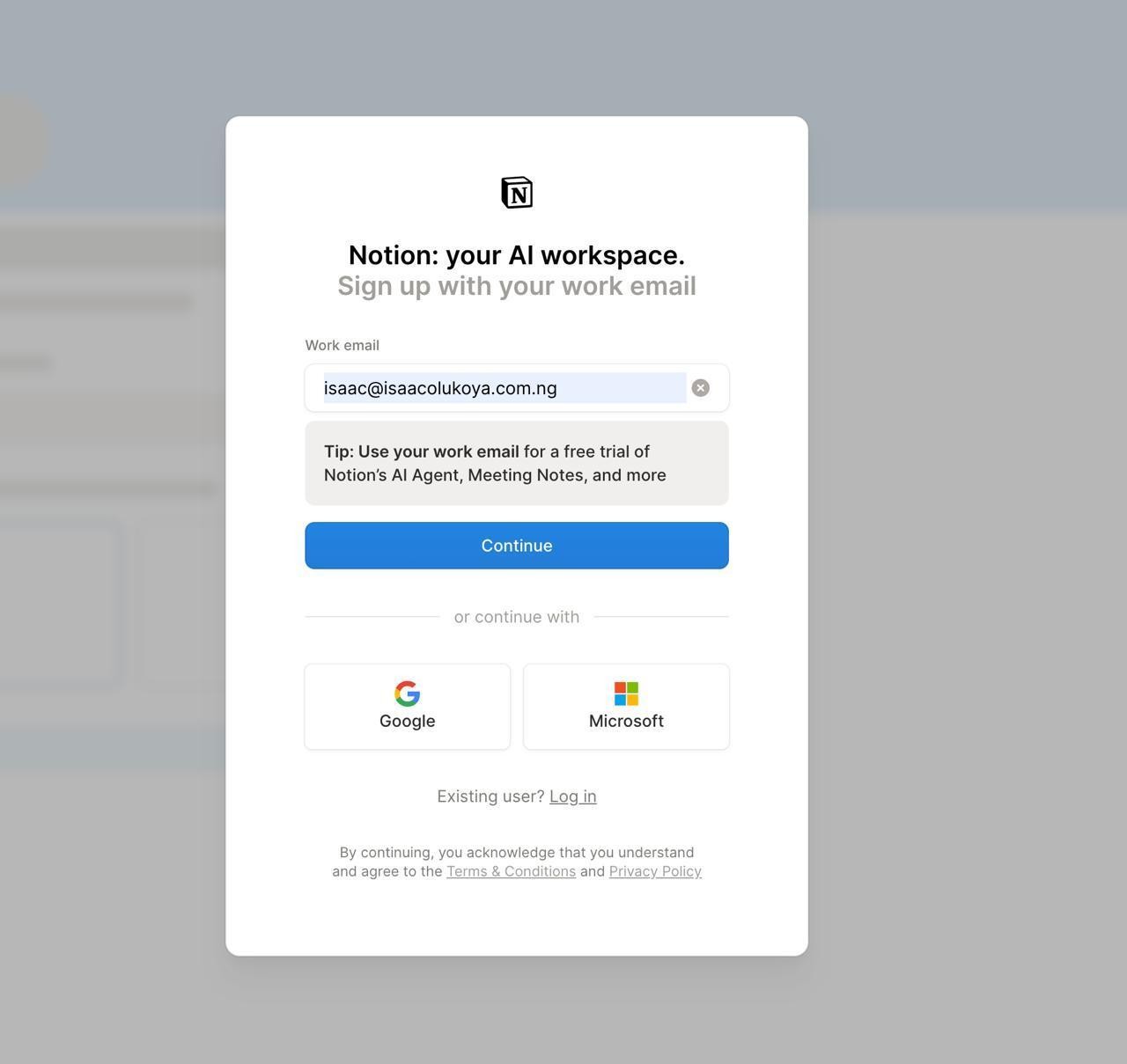
The signup page now positions Notion as ‘your AI workspace’ — the Commander identity, deployed as the primary acquisition framing. The profile screen remains structurally identical. Identity priming is intact; the identity being primed has shifted.
The fourth signal. The product now presents granular intent items mapped to the user’s declared use case. A ‘personal life’ user sees: ‘Plan a trip,’ ‘Track my spending,’ ‘Set personal goals & habits,’ ‘Keep a journal.’
The Commander transition — now observable. The welcome page features a persistent AI prompt bar: ‘Describe your own.’ The Architect-to-Commander transition predicted in the original analysis is now visible in the production interface.
Notion’s own screenJune 2026 signup: Notion positions itself as “your AI workspace” — the Commander identity, deployed as the primary acquisition framing. Open full size ↗Notion’s own screenJune 2026 welcome experience: the user’s name and their declared intent items, deployed in-product. Open full size ↗
What did not change
Fifteen minutes after completing the re-audit signup, the first lifecycle email arrived. Subject line: identical to February. Content: identical. No name. No reference to declared use case. No reference to specific intent items. A user who explicitly said ‘I want to keep a journal’ received an email promoting enterprise AI delegation workflows.
Dimension
In-product (June 2026)
Lifecycle email (June 2026)
User’s name
Used: ‘Welcome to Notion, isaac!’
Not used
Use case signal
Mapped to personalised intent items
Ignored
Specific intent items
Collected: trips, spending, journal
Not referenced
Identity framing
Personal life, consumer context
Enterprise AI delegation
Signals collected vs. deployed
4 collected, 4 used in-product
4 collected, 0 used in email
The product team built a personalised, context-aware first session. The observed lifecycle sequence remained the same un-segmented template from February.
04 · The hypothesesHypothesis
Identity mismatch & the AI question
The identity mismatch problem
Notion sells the Architect — someone who builds systems. That identity is aspirational. The hypothesis: Notion’s activation architecture cannot distinguish between the user who will become the Architect and the user who merely wants to become one. These populations have categorically different lifetime values. They look identical at signup. They diverge by day fourteen.
The behavioural signals are readable: templates installed but never customised, single-page depth, fewer than three return visits, no database creation.
The AI hypothesis: Architect → Commander
Notion’s AI transition reportedly improved early activation metrics. The Commander identity (‘direct the AI’) requires less manual investment than the Architect identity (‘build the system’).
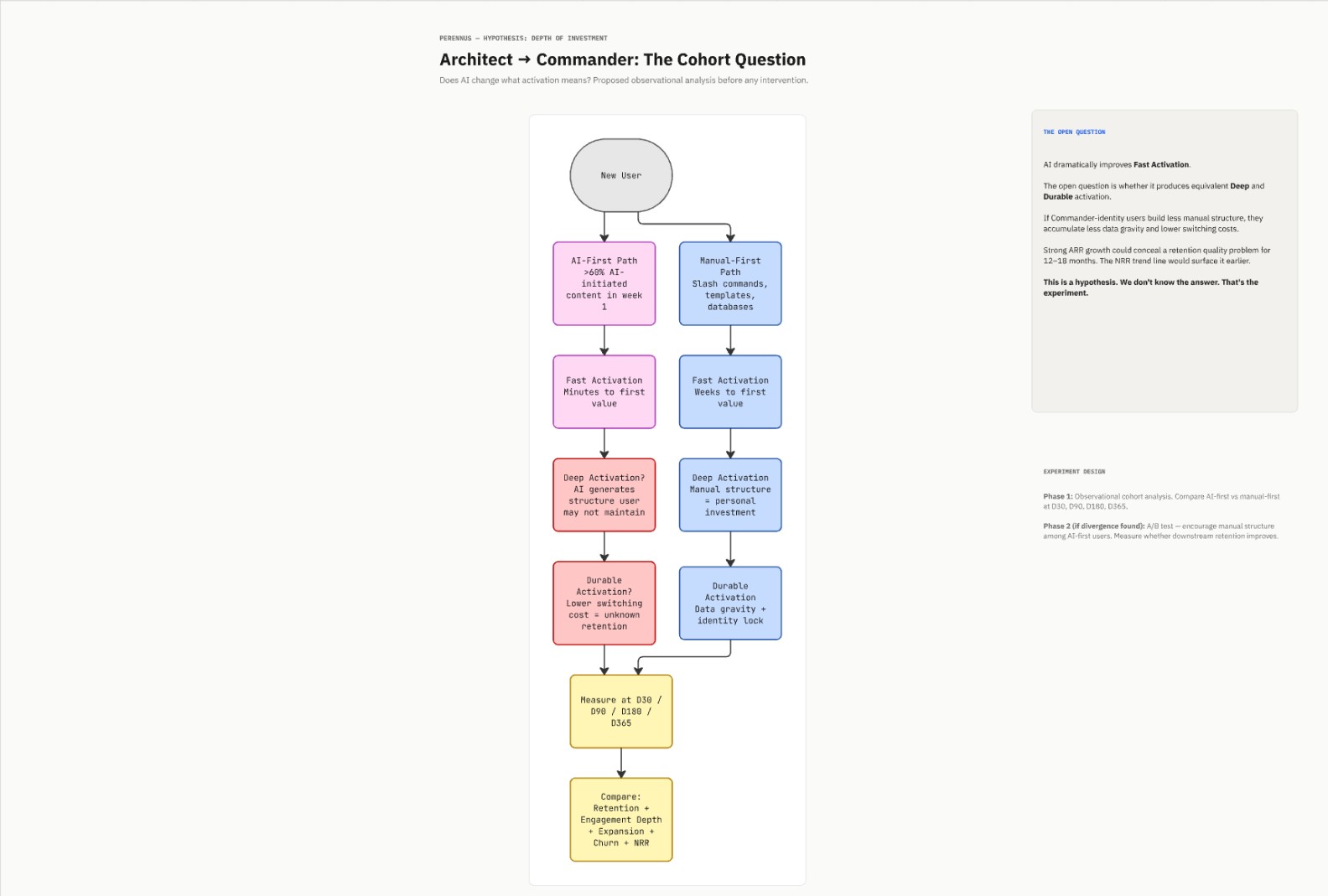
Hypothesis: if Commander-identity users build less manual structure, they accumulate less data gravity and lower switching costs — creating a potential divergence between early retention and long-term retention. This is explicitly a hypothesis, not a finding. The data required to answer it is inside Notion’s cohort analytics.
Artifact 04AI-first vs manual-first cohort model. The sidebar states its own status: “This is a hypothesis. We don’t know the answer. That’s the experiment.” Open full size ↗
Layer
What it measures
AI-first
Manual-first
Fast activation
First value moment
Minutes (strong)
Weeks (slower)
Deep activation
Structural investment
Unknown — AI generates structure user may not maintain
Dense — manual construction = personal investment
Durable activation
Compounding behavioural investment
Hypothesis: potentially lower switching cost
Very high after day-30 habit threshold
AI dramatically improves fast activation. The open question is whether it produces equivalent deep and durable activation. We don’t know the answer. That’s the experiment.
05 · The modelProposed
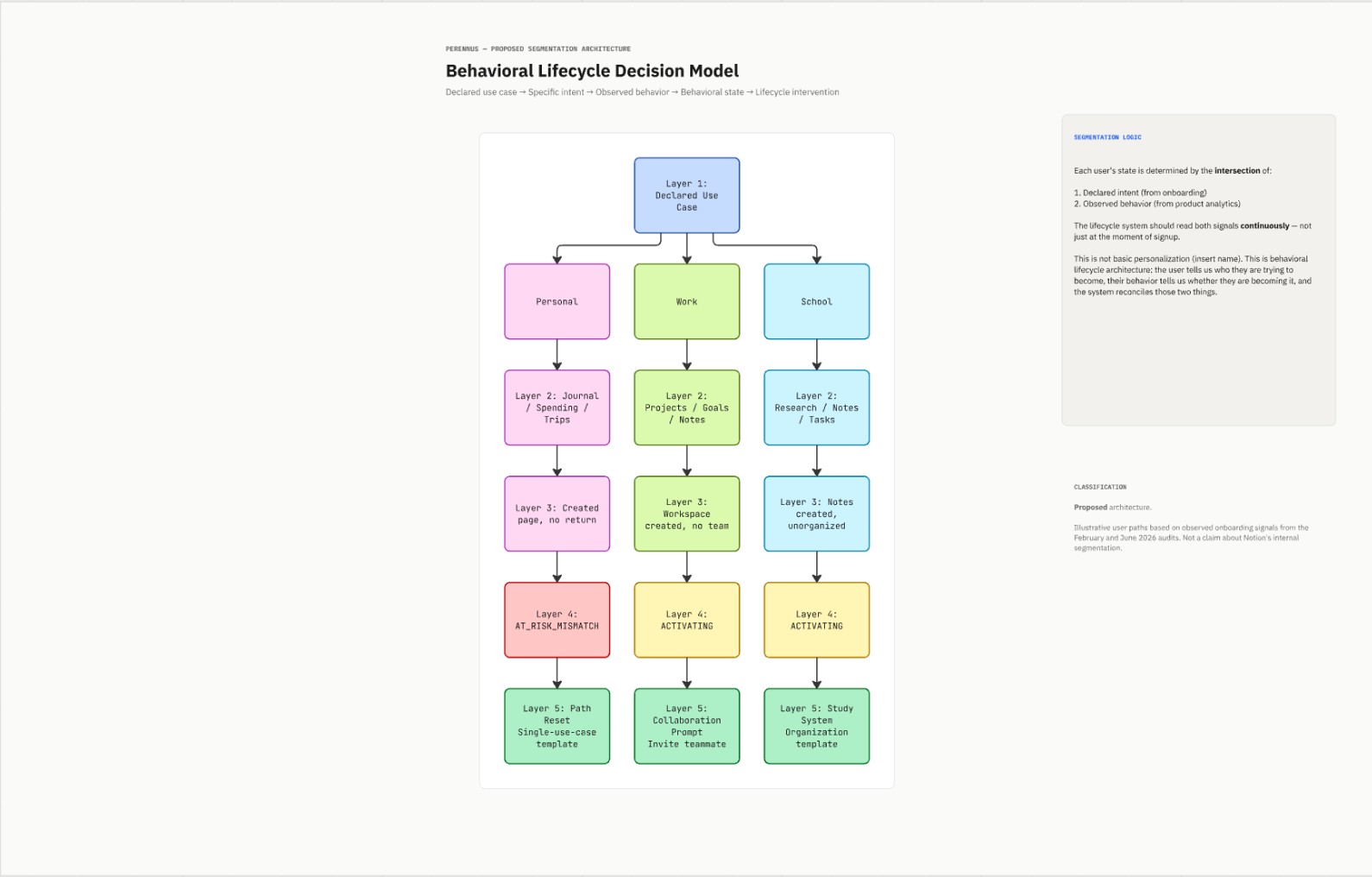
The behavioural lifecycle decision model
The observation identified the fracture. The next question: what would a lifecycle system look like if it read the behavioural signals the product already collects? The proposed model operates across five layers — and applies to all three declared use cases, not just personal users.
Artifact 03Behavioural Lifecycle Decision Model — declared use case → specific intent → observed behaviour → behavioural state → intervention, across all three declared paths. Open full size ↗
LayerPersonal pathWork pathSchool path
1Declared use caseFor personal lifeFor workFor school
Each user’s state is determined by the intersection of their declared intent (from onboarding) and their observed behaviour (from product analytics). The lifecycle system should read both signals continuously — not just at the moment of signup.
This is not basic personalisation. The user tells us who they are trying to become, their behaviour tells us whether they are becoming it, and the system reconciles those two things.
06 · ImplementationProposed
From behavioural model to executable lifecycle
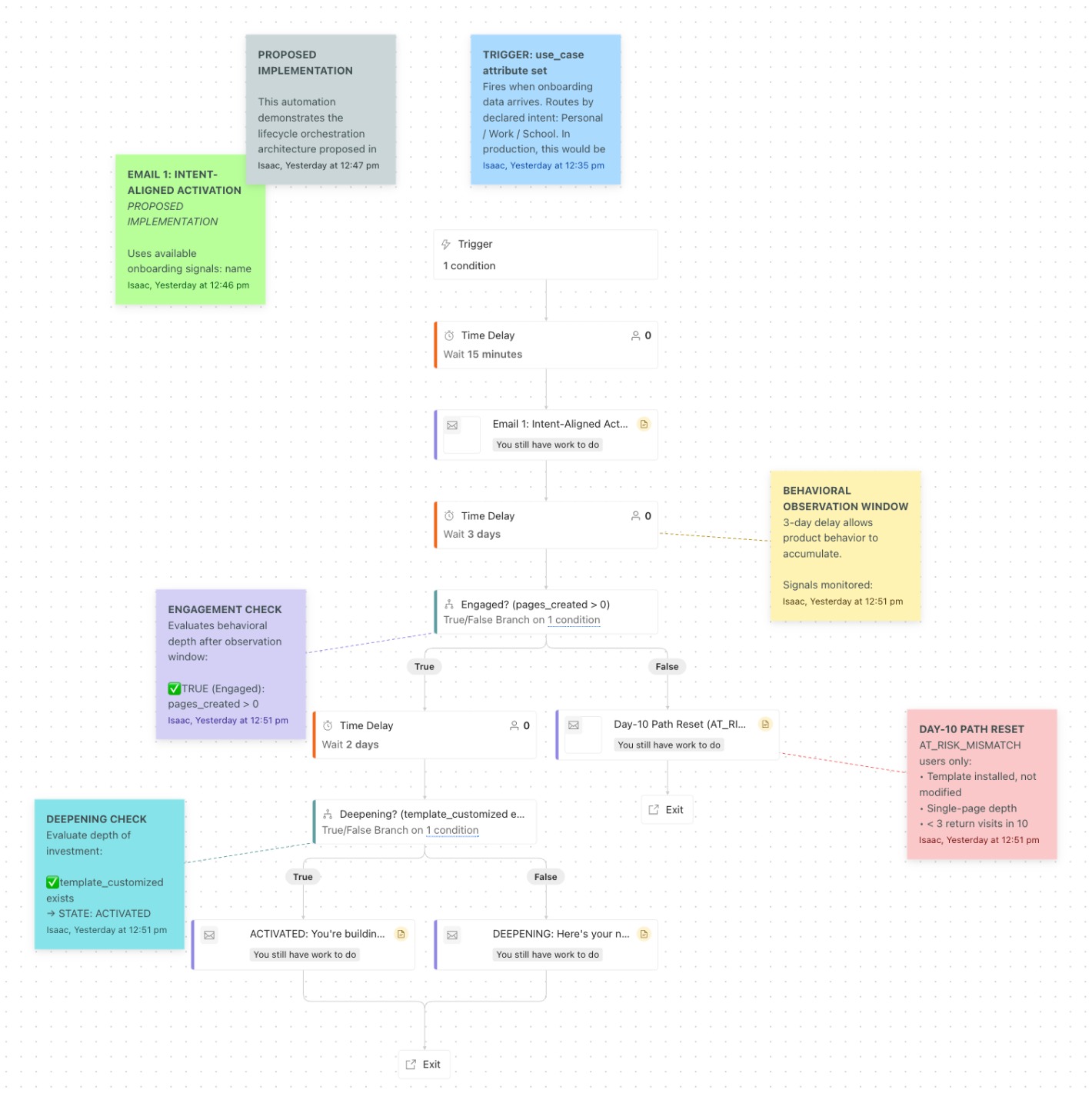
The proposed decision model translates into a Customer.io automation: onboarding context establishes the initial path, a short observation window allows behavioural signals to accumulate, and those signals determine the next intervention rather than elapsed time alone.
Artifact 05The proposed lifecycle, built in Customer.io: trigger on declared use case, an intent-aligned first email, a 3-day behavioural observation window, then branches on what the user did. Annotations are mine. Open full size ↗
Yes → deepening checktemplate_customised? → ACTIVATED. If not → deepening intervention
No → day-10 path resetSingle-use-case activation mapped to declared intent
The workflow does not blindly send the next email after three days. It observes behaviour and branches. That is the difference between elapsed-time sequencing and behavioural lifecycle orchestration.
This is a proposed implementation — not a claim about Notion’s internal automation architecture. It demonstrates how the behavioural model identified in this audit could be operationalised in a lifecycle platform.
07 · The experimentsProposed
What I would test
Three experiments. Each connects observation → hypothesis → intervention → measurement → revenue.
Experiment 01
AI-first vs manual-first cohort depth
Phase 1 · observational
Do AI-first and manual-first users exhibit different long-term behavioural depth? Compare at D30, D90, D180, D365. Measure retention, engagement depth, data gravity, collaboration, expansion, churn.
Phase 2 · if divergence found
Test whether interventions encouraging manual structure among AI-first users improve downstream retention.
Population
All new users, segmented by primary activation path in first 7 days.
Control
Current experience — both paths available, no segmentation in lifecycle.
Treatment
AI-first users receive prompts to convert AI output into manual structure.
Primary metric
D180 retention rate, segmented by AI-first vs. manual-first cohort.
Guardrails
Month-1 retention and activation rate must not degrade.
Commercial outcome
Answers whether the AI transition is strengthening or diluting the retention architecture.
Experiment 02
Day-10 identity mismatch intervention
Observation
Users who declared an identity during onboarding but haven’t developed corresponding behavioural depth by day 10.
Detection signals
Template installed but not modified + single-page depth + fewer than 3 return visits + no database creation.
Population
Users matching AT_RISK_MISMATCH state by day 10.
Control
Current lifecycle experience (generic re-engagement if any).
Treatment
Path reset: simplified single-use-case activation mapped to declared onboarding intent. One template. One completed action.
Primary metric
D30 retention rate for treated AT_RISK users vs. control.
Guardrails
Unsubscribe rate should not increase > 0.5%.
Commercial outcome
If 10% of at-risk users are recovered into the activation funnel, incremental paid conversion at scale is significant.
Experiment 03
Behavioural lifecycle orchestration
Observation
Notion collects four onboarding signals. The lifecycle system appears to use none of them.
Population
All new free-tier users. Segmented by declared use case (work / personal / school) and first-week behavioural state.
Control
Current experience — identical email sequence regardless of declared intent or behaviour.
Treatment
Behaviourally adaptive lifecycle: use case determines email sequence, name appears in every communication, feature used first determines next action, days without core action triggers intervention thresholds.
Max one lifecycle email per 48 hours. Suppress generic product marketing for users in adaptive path.
Primary metric
Time-to-activation (time from signup to first ACTIVATED-state event).
Guardrails
Email deliverability and free-to-paid conversion must not decrease.
Commercial outcome
Improving activation depth produces measurable downstream retention and expansion improvement.
08 · MeasurementProposed
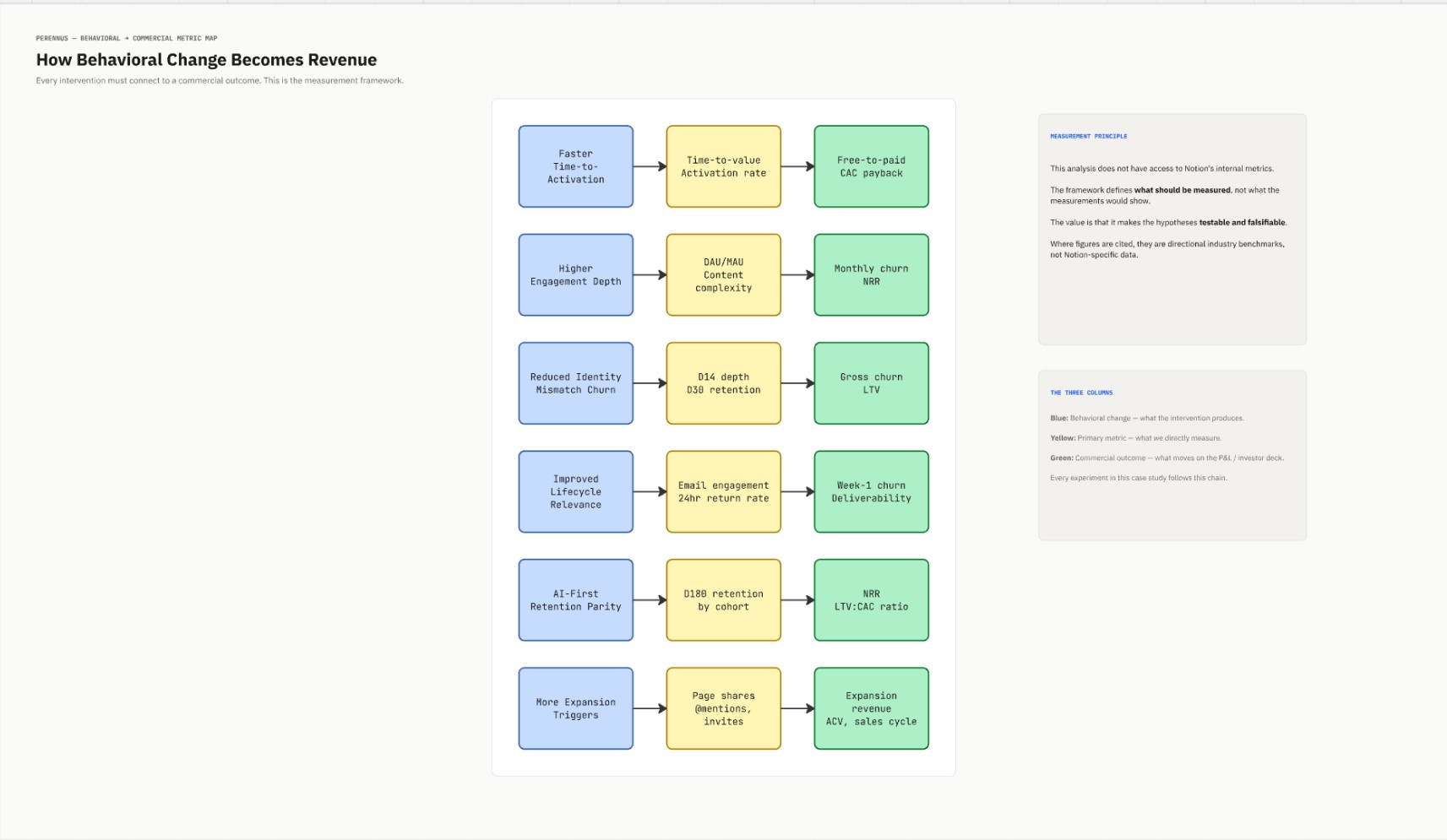
How behavioural change becomes revenue
Every intervention must connect to a commercial outcome.
Artifact 06Behavioural change → primary metric → commercial outcome. Every experiment in the case study follows this chain. Open full size ↗
Behavioural change
Primary metric
Commercial outcome
Faster time-to-activation
Time-to-value, activation rate
Free-to-paid conversion, CAC payback
Higher engagement depth
DAU/MAU, content complexity
Monthly churn, NRR
Reduced identity-mismatch churn
D14 depth, D30 retention
Gross churn, LTV
Improved lifecycle relevance
Email engagement, 24hr return rate
Week-1 churn, deliverability health
AI-first retention parity
D180 retention by cohort
NRR, LTV:CAC ratio
More expansion triggers
Page shares, @mentions, invitations
Expansion revenue, ACV, sales cycle
This analysis does not have access to Notion’s internal cohort data, conversion rates, NRR figures, or lifecycle platform configuration. Where figures are cited, they are directional estimates from industry benchmarks and published commentary, not Notion-specific measurements. The framework defines what should be measured — not what the measurements would show.
09 · Beyond NotionGeneralisation
What this means beyond Notion
The structural findings in this case study are not unique to Notion. They describe patterns common across product-led SaaS.
The product → lifecycle fracture
Most PLG companies collect behavioural data during onboarding that their lifecycle systems ignore. The product team and the lifecycle team operate from different data architectures. This is the most common and most expensive structural leak in product-led SaaS. It is also the most solvable.
The identity mismatch problem
Any product that sells an aspirational identity faces a population of users who want to inhabit that identity but cannot sustain it. The intervention is detection and path reset, not re-engagement.
The AI depth question
Any product adding AI-mediated workflows should ask: does AI deepen the user’s relationship with the product, or does it allow the user to extract value without accumulating behavioural investment?
The thinking is the product. The company is the case study.
About this work
Where this comes from.
The first in a planned series examining how PLG companies engineer user behaviour into revenue outcomes — Notion, Canva, Figma, Duolingo and Slack, concluding with a cross-company synthesis.
Primary observation
Two complete signup audits across four months, February and June 2026.
Behavioural research
Published work by Cialdini, Nunes & Dreze, and Fogg.
Benchmark data
SaaS industry benchmarks from OpenView Partners and Amplitude.
Post-publication
A conversation with Notion’s Head of EMEA Marketing, who engaged with the original research and shared it internally.
Where this document is uncertain, it says so.
This documentWhat I would do.25 pages — a decision model, an implementation and three experiments built on these findings.Read the 25-page document ↗
Its companionWhat I found.The 54-page Notion Lifecycle Autopsy — the full read of the post-signup experience, published free and in full.Read the Autopsy