A clinical assessment that decides what happens next.
Built from zero for an aviation mental health practice: a branching Typeform assessment, classification into four outcome tiers, a tier-specific lifecycle campaign for each, and an automated Slack escalation for the outcomes that needed a person rather than an email.
In aviation mental health, a slow follow-up isn’t a conversion problem. It’s a safety one.
The assessment had to do more than collect answers. It had to determine what happened next — which path someone entered, what they received, and when the team needed to know.
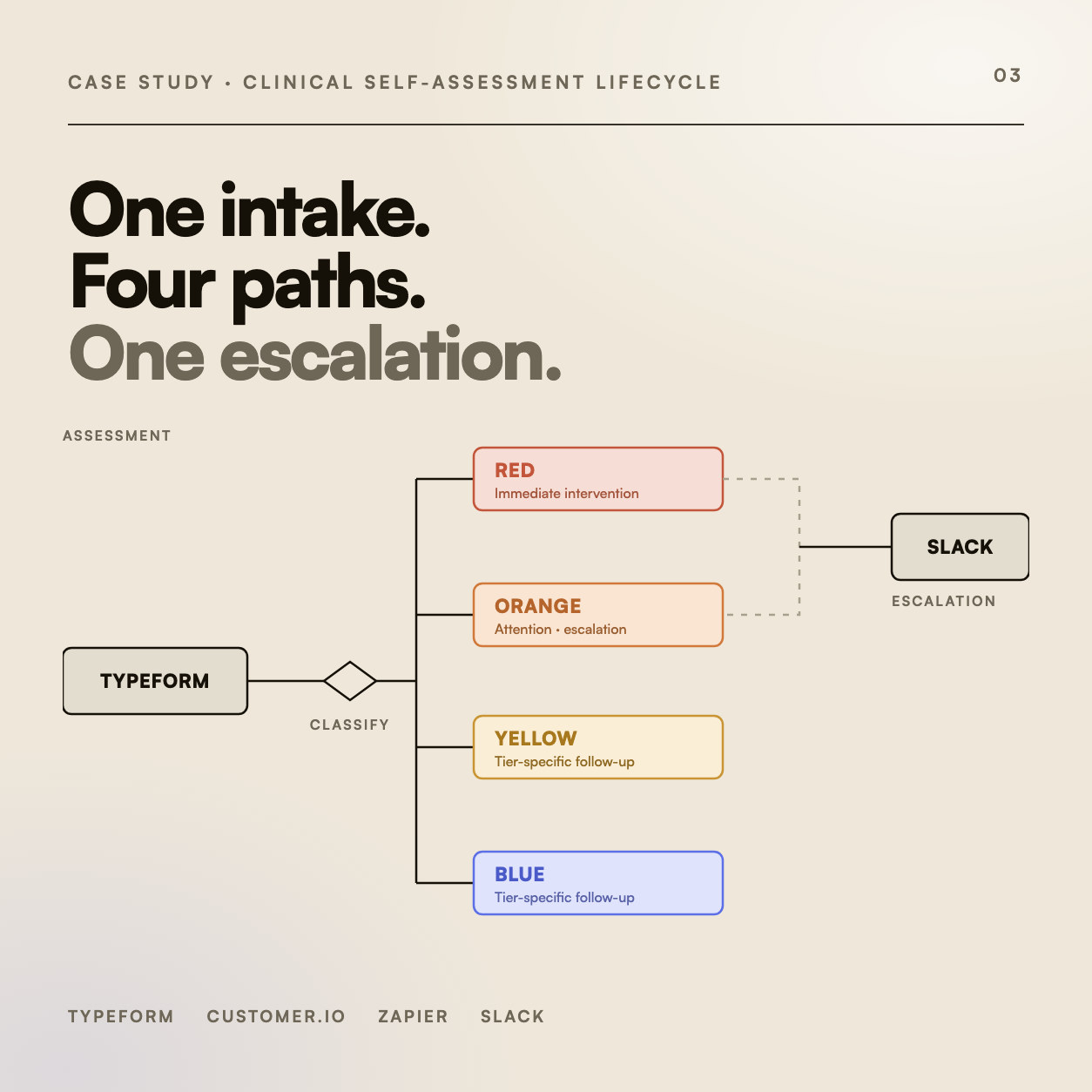
One intake. Four paths. One escalation.
A response comes in, it is classified into one of four outcome tiers, each tier has its own lifecycle campaign, and the outcomes that warrant a person leave the marketing stack entirely.
Diagram: a branching Typeform assessment feeds a classification step that resolves each respondent into one of four outcome tiers — Red, Orange, Yellow and Blue. Each tier enrols into its own five-email Customer.io campaign; the Red and Orange outcomes also post a message into the clinical team’s Slack.
“They didn’t need an online assessment. They needed an intake system that could tell different outcomes apart, move each person into the right follow-up automatically, and put the ones who mattered most in front of the clinical team.”
The client wanted more than an online assessment. They needed a complete intake and follow-up system: something that could tell different clinical outcomes apart, route each respondent into the experience that matched their result, and notify the clinical team in real time when a result warranted it.
- A branching assessment with multiple clinical pathways
- Classification into four outcome tiers
- A tier-specific follow-up journey for each outcome
- Dynamic content and behavioural, event-based triggers
- Automated campaign enrolment — nobody adding anyone by hand
- Real-time Slack alerts on high-priority outcomes
- Automated contact synchronisation
- Error handling and an end-to-end test pass
- Documentation and a handoff guide the practice could run from
Project source
The assessment was not the finished product. The system around the assessment was the work.
What the outcome decides.
The tiers are the specification. Everything downstream — which campaign fires, whether anyone is told — follows from which one a respondent lands in.
Account-confirmedTier names are the ones used in the implementation, and the Red and Orange branches are visible in the automation below. Yellow and Blue are described only by what the system does with them — the project material doesn’t define a clinical meaning for either, so none is invented here.
Built as a branching system, not a questionnaire
The assessment was designed as a branching structure: sections, conditional paths, and a final classification step that resolves every respondent into one of four endings. What someone answers determines where they come out.
That is the part that makes it a system rather than a form. A questionnaire collects answers. This one decides what happens next.

Submission → verification → contact → branch
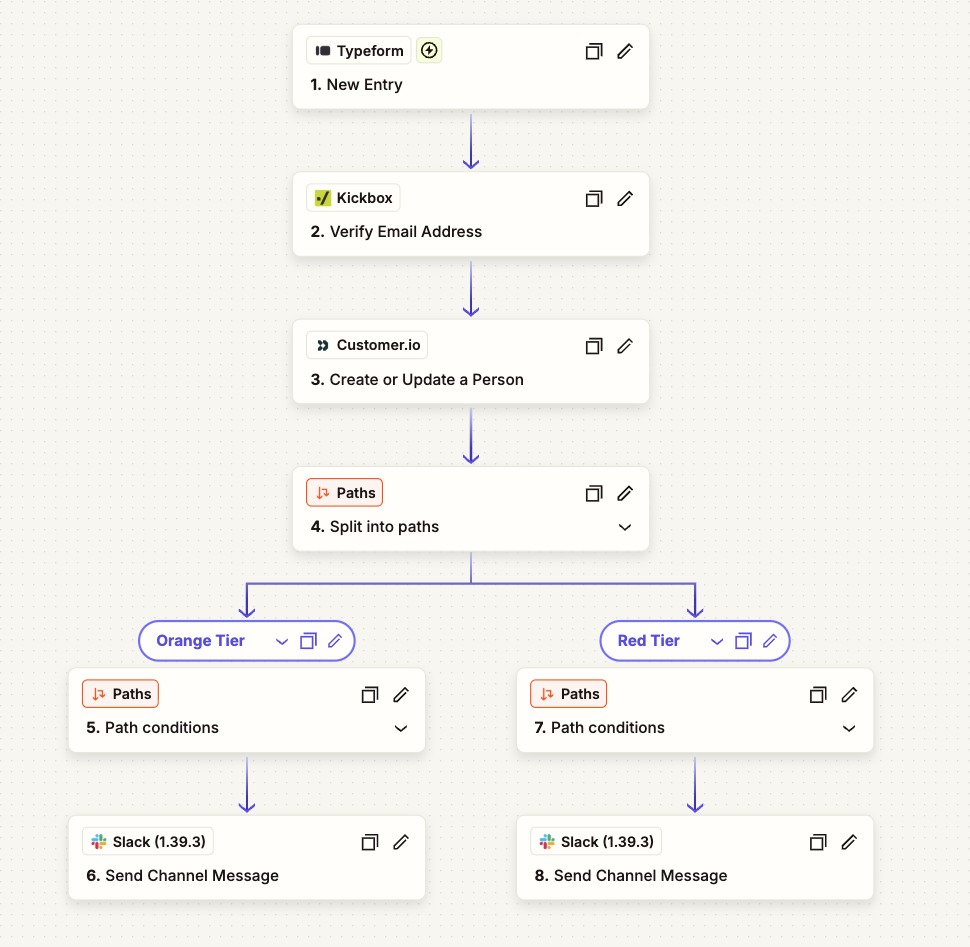
Every submission runs the same operational chain. Typeform fires the entry. Kickbox verifies the email address before anything downstream depends on it. Customer.io creates or updates the person. Then the automation splits into conditional paths by outcome tier, and the high-priority branches send a Slack channel message.
Email verification sits deliberately at step two. A clinical follow-up sequence sent to an address that doesn’t exist isn’t a deliverability problem — it’s someone who answered honestly and heard nothing back.
The outcome decides the lifecycle
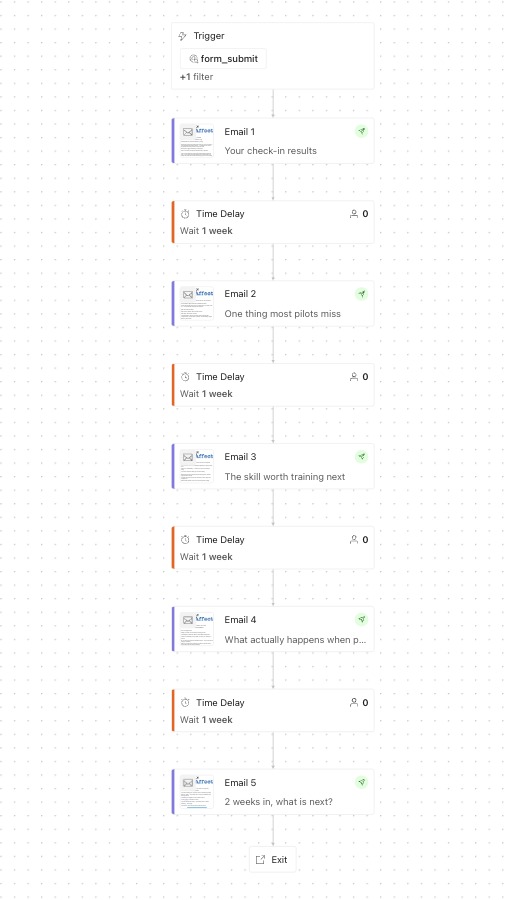
The outcome isn’t stored and forgotten. It determines which campaign the person enters. Each campaign is triggered on the form-submission event with a filter, so enrolment happens on outcome rather than by hand.
The captured campaign runs five emails a week apart, then exits: “Your check-in results”, “One thing most pilots miss”, “The skill worth training next”, “What actually happens when…”, and “2 weeks in, what is next?”. There are four of these, one per tier.
Not every outcome is an email
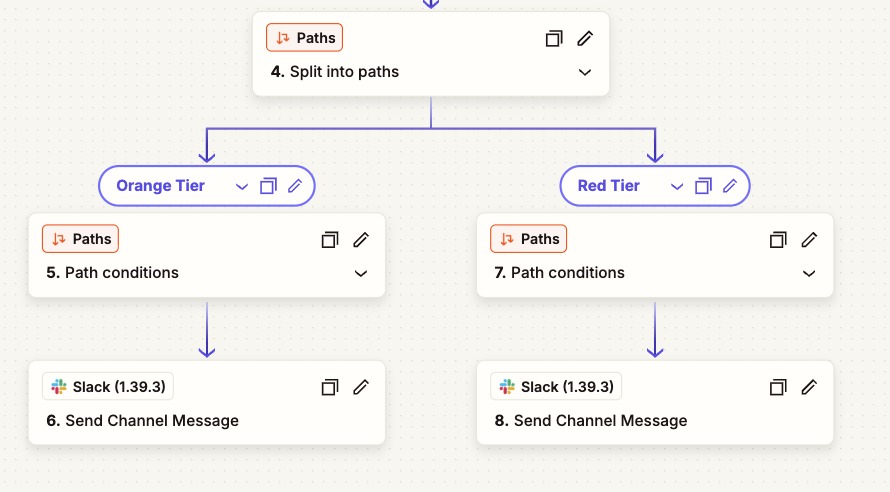
Most lifecycle work ends at the campaign. This one couldn’t. Some outcomes needed a person, not a sequence — so the automation carries a second, parallel route that leaves the marketing stack entirely and posts into the clinical team’s Slack.
Two of the four outcomes carry that route. Red is the immediate-intervention tier; Orange escalates for attention. The other two stay inside the lifecycle. The escalation is conditional and automated — it fires on the outcome, not on someone remembering to check a spreadsheet on Monday.
The result is the system.
No performance metrics were measured after handoff, and none are claimed here. What exists is the machinery, documented and handed over.
- A branching clinical assessment with four outcome paths
- Automated classification and tier-based routing
- Email verification before any downstream automation
- Automated contact creation and synchronisation
- Four tier-specific lifecycle campaigns, event-triggered and filtered
- A five-email follow-up sequence on weekly delays
- Automated Slack escalation on high-priority outcomes
- Assessment landing page in WordPress / Elementor, with consultation booking CTAs
- End-to-end QA, error handling and a full test pass
- Architecture documentation and a complete handoff guide
If the routed pipeline brings 12–15 additional pilots a month to an appropriate consultation, at an average consultation value of $350–$400, that is $50,000–$70,000 of annual consultation pipeline the system could support.
- The two inputs are assumptions
- 12–15 additional consultations a month — an assumption. The project material does not establish a volume.
- $350–$400 per consultation — an assumption. The project material does not establish a price.
A scenario estimate documented during case-study planning, not measured project revenue. Nothing in this engagement was measured after handoff.
“Did a great job. Very responsive and gave recommendations to make our product better. We will work with him again in the future.”
When an assessment decides who needs attention next, the routing logic is part of the product. I didn’t build a form and attach some emails to it — I built the system that turns a response into a next action, automatically, with a human escalation path where the outcome demanded one.